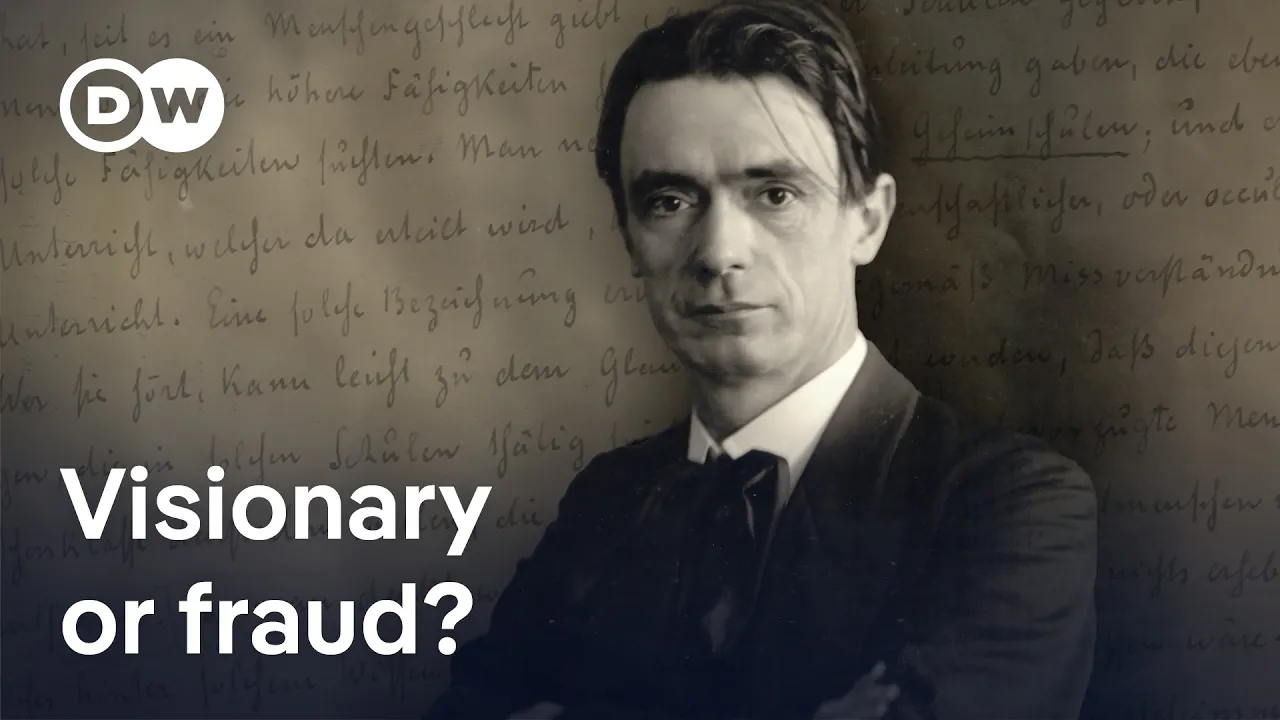
About Rudolf Steiner and his Waldorf philosophy
Rudolf Steiner is synonymous with Waldorf education - and its controversial teachings. This documentary explores the impact his ideas have had, and why they continue to draw both supporters and critics, to this day. The name Rudolf Steiner resonates. To some, he's a visionary educational reformer and humanist. To others, the founder of a world view that lies beyond scientific validity. His teachings have shaped education, agriculture and medicine - garnering plenty of criticism, along the way. The film paints a nuanced portrait of a thinker vacillating between a desire for reform and esotericism. It explores the enduring impact of his ideas and asks what role they play in the present day, at a time when scientific knowledge and social norms are increasingly coming into question. Does Steiner's esoteric world view help fuel today's skepticism towards science? ______ DW Documentary gives you knowledge beyond the headlines. Watch top documentaries from German broadcasters and international production companies. Meet intriguing people, travel to distant lands, get a look behind the complexities of daily life and build a deeper understanding of current affairs
Rudolf Steiner and his Waldorf philosophy is presented by DW Documentary. Its listed runtime is 43 minutes. The source link and publisher attribution are provided with the embedded film.
As a society documentary, Rudolf Steiner and his Waldorf philosophy uses rudolf, steiner, waldorf as its central frame. Social documentaries work best as invitations to examine systems through lived experience. Distinguish individual testimony from wider claims, and consider which institutions, incentives and inequalities shape the choices shown.
What to consider before watching
- What evidence, testimony or observation does the film use to explain rudolf, steiner, waldorf?
- Which people, institutions or historical conditions most influence the story told in Rudolf Steiner and his Waldorf philosophy?
- How does DW Documentary's framing affect the documentary's emphasis, and which perspectives may deserve further research?
Topics covered in this documentary
Documentary details and original source
- Title
- Rudolf Steiner and his Waldorf philosophy
- Category
- Society
- Runtime
- 43 minutes
- Language
- English
- Publisher
- DW Documentary
Free Documentary Vault provides independent discovery, organization and editorial context. The film remains hosted by its original publisher, who controls availability and playback.
Related Society documentaries

How do we break free from a spiral of hate? This documentary follows people in Bosnia, Mexico, and Canada who have found ways to deal with hate—and to overcome it. As the host of a children’s show, Tobi Krell is surrounded by closeness and trust. At the same time, he observes a growing coarsening of society worldwide: People treat one another with aggression, violence, and hostile stereotypes. He sets out to look for approaches to breaking the cycle of hate. In Sarajevo, he meets Adnan, a war veteran. Three decades after the end of the Bosnian War, tensions remain palpable. Adnan grapples with the question of how to dispel stereotypes—and what it takes to counter them in everyday life. In Canada, Tobi Krell meets Lauren and her mother. As a teenager, Lauren joined a far-right group. The two explain how they were able to stay in touch despite this experience—and what role personal bonds play in leaving such groups. In Monterrey, in northeastern Mexico, Anni shares her experiences with domestic violence. She shows how she has learned to reflect on
DW DocumentaryHow to unlearn hate - Stories of courage, hope, and reconciliation

Why do people in Europe refer to them as "Arabic numerals" when they were invented in India? How could ten tiny symbols conquer the world? And how did zero change the course of history? The Western world calls them "Arabic numerals," while in the Arab world, today's European notation is thought of as being Western. What is "Arabic" about the symbols that traveled from India to Europe and on to the rest of the world? Following the trail of our numbers leads us to Baghdad. There, in the eighth century, a scholar named al-Khwarizmi — Latinized as "Algorismi," later to be found in the word "algorithm" — helped spread Indian numerals. He would become known as the father of modern algebra. The "Arabic" numerals commonly used in Europe today derive from another variant, known as "Ghubar" — Arabic for "dust." That had emerged from the so-called "dust tables" used by Maghrebi merchants around the Mediterranean. From Europe to America, and from the dawn of modern science to the computer age — the fascinating history of these ten small digits is
DW DocumentaryFrom 0 to 9 - The mysterious origins of our numbers

Could Germany become a hotspot for the global markets of the future? Young startup founders are using cutting-edge innovations to tackle tomorrow's biggest challenges. They're not just dreaming about the future — they're building it. With humanoid robots, climate-friendly chocolate and next-generation semiconductors, they just might transform entire industries. David Reger, founder of NEURA Robotics, is developing intelligent humanoid robots with his team in Metzingen, Germany — not to replace people, but to assist them: in the home, in caregiving and in dangerous situations. Speed and efficiency are the focus for brothers Sebastian and Daniel Schall, the minds behind Black Semiconductor. Their chip technology combines electrical and optical data transmission — a small revolution in the semiconductor market. In a purpose-built high-tech production facility in Aachen, Germany, international experts are laying the foundations for tomorrow's energy efficiency — creating a cornerstone for artificial intelligence, autonomous driving and the digital transformation. Twins Sara and Max Marquart, founders of Planet A Foods, are exploring the future of what we eat. Their goal: to complement cocoa and coffee — crops increasingly affected by
DW DocumentaryHumanoid robots and new chips - Will Germany become a tech hotspot?

A cinematic journey through the first year of Donald Trump's second term as president. Fear, hope, protest, loyalty and disappointment all shape this portrait of the US as a nation in turmoil. Washington, D.C., and Piedmont, West Virginia. As President Trump's second term sparks fear and alarm in the liberal capital, coal country in Appalachia clings to the hope of a long-awaited economic turnaround. Only a two-and-a-half-hour drive separates Washington, D.C., from Piedmont, West Virginia — yet the two places exist in hugely different cultural worlds. In liberal D.C., shock about Donald Trump's return for a second term runs deep. Many federal workers fear for their jobs, rights and democracy. In coal country, by contrast, Trump is seen as the last hope for an economic revival. Coal trains may still rumble through town, but factories stand empty and drug problems are tearing through the community. Even so, there's tremendous resilience to be found here. This documentary follows both places over the course of a year, exploring how people with sharply contrasting realities see Trump's return to the presidency. In Washington
DW DocumentaryTrump and power - A deep divide across America

From a retinal implant that allows a blind man to perceive his wife's face after 33 years to a jacket that recreates the sensation of a hug and devices that electrically stimulate the tongue to simulate taste, this documentary explores extraordinary inventions attempting to recreate some of our most fundamental human senses
Naked ScienceBreakthrough Technology Helps Blind Man See His Wife For First Time

After a series of fatal shark attacks, Australia is turning toward high-tech solutions. This includes drones, smart capture systems and cutting-edge research, which — unlike shark nets — don't harm the predatory fish. Marine biologist Paul Butcher heads the New South Wales shark management program, which introduced smart drumlines that allow sharks to be caught alive before being tagged and released without hurting them. The program is aided by the world's largest drone-based beach surveillance system. One of Butcher's key collaborators is Mark Atkins, who oversees the drone program. The system delivers real-time warnings for swimmers and surfers, while airborne cameras also provide researchers with valuable data on shark movements. Drone operator Gabriel Roxburgh conducts patrols of Bellina's coastline. He is taking a closer look at the new arrival of massive schools of baitfish, because he knows that, where prey gathers, large predators usually follow. But the high-tech approach also has its critics. Surfer and shark-control activist Daniel Webber says stronger measures are needed, and that the move away from traditional shark nets puts human lives at risk. In neighboring
DW Documentary