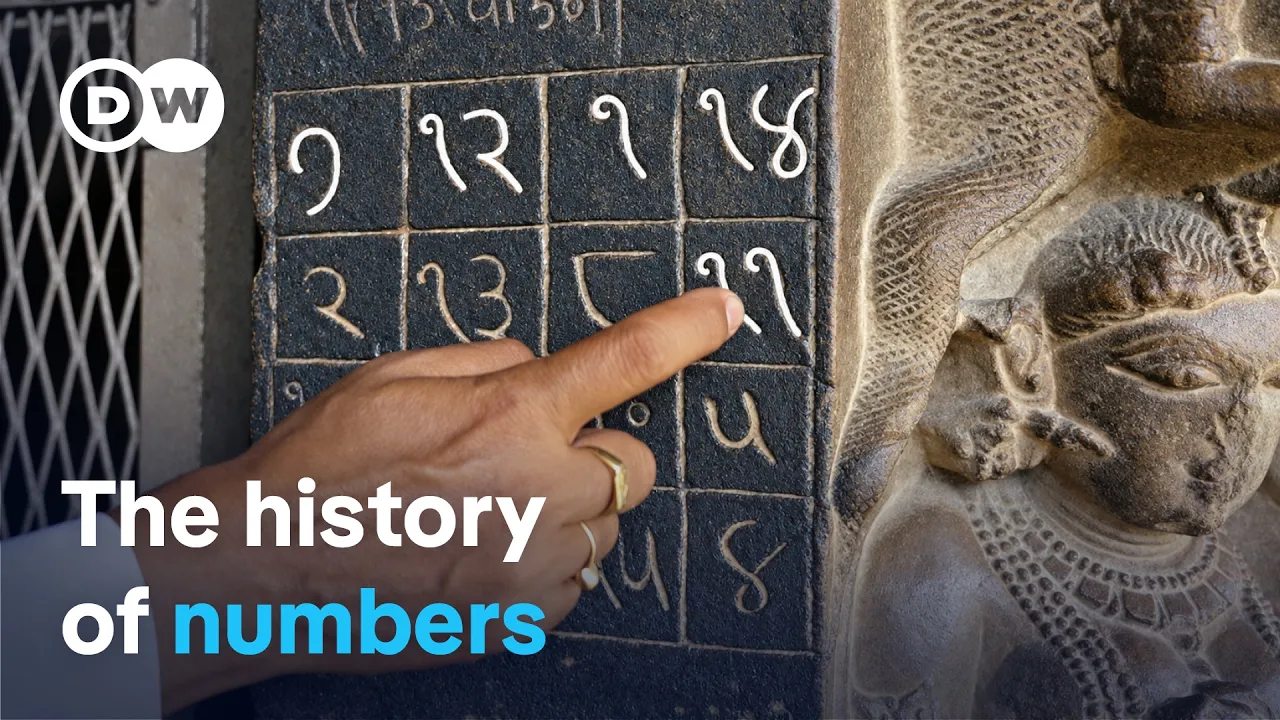
About From 0 to 9 - The mysterious origins of our numbers
Why do people in Europe refer to them as "Arabic numerals" when they were invented in India? How could ten tiny symbols conquer the world? And how did zero change the course of history? The Western world calls them "Arabic numerals," while in the Arab world, today's European notation is thought of as being Western. What is "Arabic" about the symbols that traveled from India to Europe and on to the rest of the world? Following the trail of our numbers leads us to Baghdad. There, in the eighth century, a scholar named al-Khwarizmi — Latinized as "Algorismi," later to be found in the word "algorithm" — helped spread Indian numerals. He would become known as the father of modern algebra. The "Arabic" numerals commonly used in Europe today derive from another variant, known as "Ghubar" — Arabic for "dust." That had emerged from the so-called "dust tables" used by Maghrebi merchants around the Mediterranean. From Europe to America, and from the dawn of modern science to the computer age — the fascinating history of these ten small digits is
From 0 to 9 - The mysterious origins of our numbers is presented by DW Documentary. Its listed runtime is 52 minutes. The source link and publisher attribution are provided with the embedded film.
As a society documentary, From 0 to 9 - The mysterious origins of our numbers uses mysterious, origins, numbers as its central frame. Social documentaries work best as invitations to examine systems through lived experience. Distinguish individual testimony from wider claims, and consider which institutions, incentives and inequalities shape the choices shown.
What to consider before watching
- What evidence, testimony or observation does the film use to explain mysterious, origins, numbers?
- Which people, institutions or historical conditions most influence the story told in From 0 to 9 - The mysterious origins of our numbers?
- How does DW Documentary's framing affect the documentary's emphasis, and which perspectives may deserve further research?
Topics covered in this documentary
Documentary details and original source
- Title
- From 0 to 9 - The mysterious origins of our numbers
- Category
- Society
- Runtime
- 52 minutes
- Language
- English
- Publisher
- DW Documentary
Free Documentary Vault provides independent discovery, organization and editorial context. The film remains hosted by its original publisher, who controls availability and playback.
Related Society documentaries

In 2024, several Latin Americans were caught committing sabotage on behalf of Russia. A DW investigation reveals how they came to work for Moscow's secret services and who recruited them. It started with an arson attack at a Polish construction-supply business and continued with arrests in Czechia and Romania for similar offenses. Just weeks later, Lithuanian investigators uncovered a plot to set fire to military equipment. All of the suspects were from Spanish-speaking countries, but investigators traced the actions back to Russia's secret services - and a Cuban dance teacher in Russia, Oemis Romagoza Durruthy. DW and three other European broadcasters have spent more than a year looking into this case. This documentary reveals how Russia reached across continents to organize a destabilizing campaign against Europe and follow the trail of these attacks to a dance studio in Russia. ______ DW Documentary gives you knowledge beyond the headlines. Watch top documentaries from German broadcasters and international production companies. Meet intriguing people, travel to distant lands, get a look behind the complexities of daily life and build a deeper understanding of
DW DocumentaryThe Latin dance teacher directing Russia's sabotage in Europe

1789 shattered old certainties and ignited Romantic art. This episode traces how revolution, the sublime, and the individual reshaped painting across Europe. From the fall of the Bastille, Western artists challenged neoclassical rules and elevated private feeling, nature, and the heroic or tragic individual. We unpack Edmund Burke's pairing of beauty and the sublime and Jean-Jacques Rousseau's call for the dignity of the individual that fueled this turn. In France, Jacques-Louis David bridges neoclassicism and romantic impulse, from the Oath of the Horatii to Napoleon at the St Bernard Pass, while his pupil Antoine-Jean Gros intensifies emotion. Théodore Géricault transforms a recent disaster into monumental history in The Raft of the Medusa, rebuilding the raft from a survivor's model and seizing the moment a rescue ship is sighted but sails on; later he explores extreme states in portraits from an asylum. Eugène Delacroix advances the movement with Dante and Virgil, The Massacre at Chios, The Death of Sardanapalus, and the emblematic Liberty Leading the People, where a red-capped, tricolor-bearing Liberty strides with citizens of every class over the July barricades.
Absolute HistoryRomanticism After 1789: Géricault's Raft, Delacroix's Liberty, Turner and Goya

People on the autism spectrum have dreams like many other people’s: love, a career, friendships. But the path to achieving them is often strewn with challenges. "Life on the Spectrum" tells the stories of Sebastian, Lena, Diane and Elias. With sensitivity and intimacy, it shows us just how varied and complicated life with autism can be. There’s Sebastian, who's looking for a partner. Lena wants to become a doctor, despite all the setbacks she has faced. And Diane, who wants to help her son Elias settle into school life, but keeps encountering obstacles in the process. They offer us moving insights into their lives at these pivotal moments. The documentary doesn't focus on the diagnosis, but rather on the people themselves, with their hopes, strengths and vulnerabilities. With a gentle camera style and a visual language that also brings inner landscapes to life, the documentary opens doors to a world that's still unfamiliar to many. ______ DW Documentary gives you knowledge beyond the headlines. Watch top documentaries from German broadcasters and international production companies. Meet intriguing people, travel to distant
DW DocumentaryLife on the autism spectrum (2/2)

How do we break free from a spiral of hate? This documentary follows people in Bosnia, Mexico, and Canada who have found ways to deal with hate—and to overcome it. As the host of a children’s show, Tobi Krell is surrounded by closeness and trust. At the same time, he observes a growing coarsening of society worldwide: People treat one another with aggression, violence, and hostile stereotypes. He sets out to look for approaches to breaking the cycle of hate. In Sarajevo, he meets Adnan, a war veteran. Three decades after the end of the Bosnian War, tensions remain palpable. Adnan grapples with the question of how to dispel stereotypes—and what it takes to counter them in everyday life. In Canada, Tobi Krell meets Lauren and her mother. As a teenager, Lauren joined a far-right group. The two explain how they were able to stay in touch despite this experience—and what role personal bonds play in leaving such groups. In Monterrey, in northeastern Mexico, Anni shares her experiences with domestic violence. She shows how she has learned to reflect on
DW DocumentaryHow to unlearn hate - Stories of courage, hope, and reconciliation

Could Germany become a hotspot for the global markets of the future? Young startup founders are using cutting-edge innovations to tackle tomorrow's biggest challenges. They're not just dreaming about the future — they're building it. With humanoid robots, climate-friendly chocolate and next-generation semiconductors, they just might transform entire industries. David Reger, founder of NEURA Robotics, is developing intelligent humanoid robots with his team in Metzingen, Germany — not to replace people, but to assist them: in the home, in caregiving and in dangerous situations. Speed and efficiency are the focus for brothers Sebastian and Daniel Schall, the minds behind Black Semiconductor. Their chip technology combines electrical and optical data transmission — a small revolution in the semiconductor market. In a purpose-built high-tech production facility in Aachen, Germany, international experts are laying the foundations for tomorrow's energy efficiency — creating a cornerstone for artificial intelligence, autonomous driving and the digital transformation. Twins Sara and Max Marquart, founders of Planet A Foods, are exploring the future of what we eat. Their goal: to complement cocoa and coffee — crops increasingly affected by
DW DocumentaryHumanoid robots and new chips - Will Germany become a tech hotspot?

Tony Robinson explores the lives of ordinary people who shaped Britain during the 1950s. From an Irish nurse who escaped home to help victims of a devastating train crash to factory workers, rag-and-bone men, struggling housewives and a Jamaican RAF veteran turned pop star, their stories reveal how post-war Britain was rebuilt.
Journal - History Documentaries