
About Why Islamic Art Challenges The Dark Ages Myth | An Age of Light
To the south and east of Christendom, the new religion of Islam spread from its Arabian birthplace throughout the Middle East, across North Africa, and into Spain. As it did so, Islam imparted its own distinctive forms of architecture, ways to gaze at the stars, and art designed to depict the wonders of paradise.
Why Islamic Art Challenges The Dark Ages Myth | An Age of Light is presented by Real History. Its listed runtime is 60 minutes. The source link and publisher attribution are provided with the embedded film.
As a society documentary, Why Islamic Art Challenges The Dark Ages Myth | An Age of Light uses islamic, challenges, light as its central frame. Social documentaries work best as invitations to examine systems through lived experience. Distinguish individual testimony from wider claims, and consider which institutions, incentives and inequalities shape the choices shown.
What to consider before watching
- What evidence, testimony or observation does the film use to explain islamic, challenges, light?
- Which people, institutions or historical conditions most influence the story told in Why Islamic Art Challenges The Dark Ages Myth | An Age of Light?
- How does Real History's framing affect the documentary's emphasis, and which perspectives may deserve further research?
Topics covered in this documentary
Documentary details and original source
- Title
- Why Islamic Art Challenges The Dark Ages Myth | An Age of Light
- Category
- Society
- Runtime
- 60 minutes
- Language
- English
- Publisher
- Real History
Free Documentary Vault provides independent discovery, organization and editorial context. The film remains hosted by its original publisher, who controls availability and playback.
Related Society documentaries

Across the waters of the North Sea, the Vikings launched raids on the coasts of Britain and Ireland, targeting monasteries like Lindisfarne, where monks produced illuminated manuscripts of breathtaking beauty. Yet the Vikings who terrorized Dark Age Europe spent as much time creating their own stunning artwork as they did stealing it from others.
Real HistoryThe Surprising Intricacies Of Viking Art | The Dark Ages: An Age of Light

From Tobruk to El Alamein and Operation Torch, see how Montgomery's 8th Army broke Rommel and ended Axis power in North Africa. June 11, 1940: Italy enters the war, threatening Suez and Britain's lifelines. Outnumbered in men and aircraft, General Wavell faces 250,000 Italian troops with thin forces from Egypt to East Africa. Early raids give way to bold counterblows as Bardia falls and Tobruk is taken, but the arrival of General Erwin Rommel and the Afrika Korps reverses fortunes. The siege of Tobruk grinds on, Halfaya Pass is a bruising contest, and on 21 June 1942 Tobruk falls, which Churchill calls one of the heaviest blows he could recall. Churchill arrives with new leadership: General Alexander and General Montgomery. With fresh Sherman tanks and RAF cover, Monty launches Operation Lightfoot on 23 October 1942, a night-long barrage that shocks the Axis. Fighting through deep minefields and fierce counterattacks, the Allies wear the enemy down. Operation Supercharge on 2 November breaks the line and forces a retreat. The 8th Army pursues fast, regaining Mersa Matruh, recapturing Tobruk on 13 November
Real HistoryEl Alamein to Tunis: How Montgomery Broke Rommel's Afrika Korps

Even from the early years, WW2 would be marked as a war that evolved with the rapid technological advances made throughout its 6 year duration. Two of these huge advances were the recent invention of the U-Boat and how these were put into practical application to take the war global. The other is the B-17 Flying Fortress bomber, an incredibly advanced aerial bomber that changed the meaning of aerial warfare.
Real HistoryTwo Of WW2's Most Feared Weapons | Wolfpack/Flying Fortress

From the omen of 1066's long-haired star to Hastings and the Harrowing of the North, this episode charts William the Conqueror's brutal rise. In History Makers, we trace the Norman story from Viking roots to the making of a king. We meet Rolf the Ganger and the birth of Normandy under Charles the Simple, then enter William's perilous childhood: assassination plots, the murder of his guardian Osborne Crepon, and years of anarchy. We see the young duke's iron resolve at Alençon, where taunts of "hides for the tanner" triggered a ruthless reprisal, and his strategic marriage to Matilda of Flanders. With Edward the Confessor's death, rival claims ignite. We examine Harold Godwinson's disputed oath in Normandy, William's papal-backed invasion force, and the contrasting battle doctrines of Norman combined arms of archers, spearmen and cavalry, as shown on the Bayeux Tapestry, versus the Anglo-Saxon shield wall and Dane axes. After Harold's dash north to defeat Harald Hardrada and Tostig at Stamford Bridge, the stage is set at Senlac Hill. At Hastings, arrows, infantry and cavalry grind at the Saxon line. When
Real History1066 Hastings: William's 'I Still Live' and the Harrowing of the North

A 500-mile trek across Pakistan hunts the truth behind Shangri-La, from the Indus and Nangaparbat to Hunza's timeless forts, shamans, and polo fields. Explorer David Adams traces James Hilton's Lost Horizon across the Himalayas and the Karakoram. Starting in Peshawar to track down the 1930s novel, he follows the Indus River past K2 toward a valley some believe inspired a hidden utopia where people live long, peaceful lives. Along the way the journey collides with reality: deep snow near Nangaparbat, crevasse-riddled glaciers, and a race against an early winter that can close high passes for months. In the Bomboret Valley he meets the Kalash, a non-Muslim mountain people whose graveyards have been desecrated and whose blue eyes and blond hair are, in local lore, linked to Alexander the Great. In Chitral, wild horsemen play bushkazi, grappling over a headless goat in a no-holds-barred contest. Crossing the Lowari Pass becomes an eight-hour crawl for just 50 miles as snowfall chokes the road. In the Swat Valley, the remnants of a Buddhist past peek through, their faces stoned away in a region
Real HistoryIs Hunza the Real Shangri-La? Indus to Nangaparbat
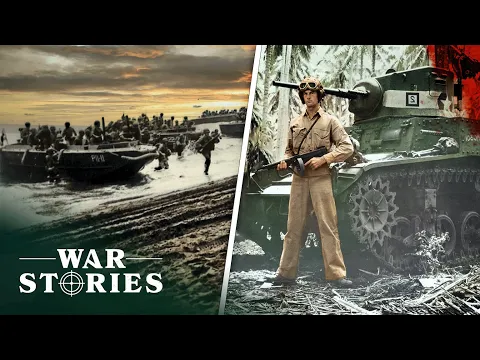
After Japan's attack on Pearl Harbor, their empire expanded rapidly across the Pacific. But the tide began to turn as the Americans launched their first major offensive against Japan on the island of Guadalcanal. Witness the challenges faced by both American and Japanese troops in the unforgiving jungle. War Stories is your one stop shop for all things military history. From Waterloo to Verdun, we'll be bringing you only the best documentaries and stories from history's most engaging and dramatic conflicts. You can find more from us on
War Stories