
About Who was The Most Feared Tank Commanders Of WWII? | Greatest Tank Battles
In WWII tank commanders were king. And the likes of Patton, Rommel, Montgomery and Michael Wittmann were among the best. From North Africa and the campaigns at Tobruk, El Alamein, and Kasserine Pass to the fields of Northern France after D-Day, this extended cut of Greatest Tank Battles takes us on a journey through WWII and how these fearsome tank commanders succeeded and defeated one another. War Stories is your one stop shop for all things military history. From Waterloo to Verdun, we'll be bringing you only the best documentaries and stories from history's most engaging and dramatic conflicts. You can find more from us on
Who was The Most Feared Tank Commanders Of WWII? | Greatest Tank Battles is presented by War Stories. Its listed runtime is 139 minutes. The source link and publisher attribution are provided with the embedded film.
As a society documentary, Who was The Most Feared Tank Commanders Of WWII? | Greatest Tank Battles uses feared, commanders, battles as its central frame. Social documentaries work best as invitations to examine systems through lived experience. Distinguish individual testimony from wider claims, and consider which institutions, incentives and inequalities shape the choices shown.
What to consider before watching
- What evidence, testimony or observation does the film use to explain feared, commanders, battles?
- Which people, institutions or historical conditions most influence the story told in Who was The Most Feared Tank Commanders Of WWII? | Greatest Tank Battles?
- How does War Stories' framing affect the documentary's emphasis, and which perspectives may deserve further research?
Topics covered in this documentary
Documentary details and original source
- Title
- Who was The Most Feared Tank Commanders Of WWII? | Greatest Tank Battles
- Category
- Society
- Runtime
- 139 minutes
- Language
- English
- Publisher
- War Stories
Free Documentary Vault provides independent discovery, organization and editorial context. The film remains hosted by its original publisher, who controls availability and playback.
Related Society documentaries

The Black Watch Snipers were some of the finest soldiers in WWII. From D-Day on into the heart of Northern France, Belgium and Germany they fought like no one else and putting themselves in unimaginable danger. In this exclusive episode we hear from the men of the Black Watch as they remember their lives during WWII, and meet up for one last time to see if they've still got what it takes to be a great shot. War Stories is your one stop shop for all things military history. From Waterloo to Verdun, we'll be bringing you only the best documentaries and stories from history's most engaging and dramatic conflicts. You can find more from us on
War StoriesThe Truth Behind Life As A Sniper In WWII | Black Watch Snipers

Since 1948, fierce tank battles have been fought across the Sinai Peninsula. From the founding of the State of Israel to the Six-Day War and on to the October War of 1973. This episode of Greatest Tank Battles looks at some of these conflicts and takes us on a deep dive into what life was really like for the soldiers who fought there. War Stories is your one stop shop for all things military history. From Waterloo to Verdun, we'll be bringing you only the best documentaries and stories from history's most engaging and dramatic conflicts. You can find more from us on
War StoriesThe Fierce Tank Combat Strategies Of The Arab–Israeli Wars | Greatest Tank Battles

The Battles of Imphal and Kohima were a crucial turning point in the attempted Japanese invasion of India during World War Two. By October 1942 Singapore, Hong-Kong, Malaysia and Burma had all fallen to the Japanese; the Imperial army looked unbeatable. Yet it was then, when morale was at its lowest, that the new British commander Bill Slim set about reforming and rebuilding the Anglo-Indian British army. Slim aimed to revive Allied fortunes in the region – something many believed was an impossible task. Meanwhile, Japanese commander Renya Mutaguchi had ambitious plans of his own: the conquest of British India. To initiate this plan the Japanese first had to capture one key strategic town: Imphal, the gateway to India. The very close-run battles that followed - fought between March and July 1944 - were clashes on epic proportions as each side attempted to execute a master plan of their respective visionary generals. If they succeeded, Slim knew the British would have a strong base from where they could commence their reconquest of Burma and quell the rise of Japan. If
History HitHow Did The Allies Stop Japan From Conquering India?
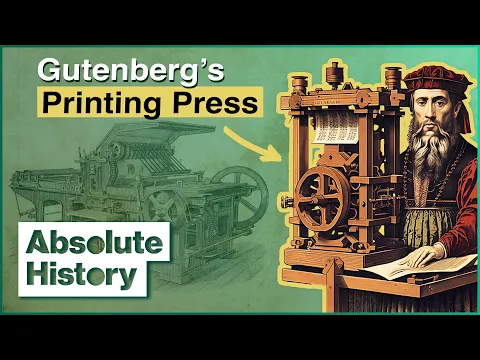
Stephen Fry takes a look at the story of Johannes Gutenberg, inventor of the world's first printing press in the 15th century. Beginning with religious works and textbooks, soon presses were churning out all manner of texts from Reformation pamphlets to romantic novels. The number of books greatly increased, their cost diminished and so more people read than ever before.
Absolute HistoryWhy The Printing Press Is The Most Important Invention Of All Time

What began as a bitter, ego-driven feud between Allied commanders accidentally created the most devastating air strategy in military history. In 1943, American planners insisted on high-stakes daylight precision bombing, while the British fiercely argued for nighttime saturation. Forced to compromise at the Casablanca Conference, they birthed the Combined Bomber Offensive. By splitting the skies — US by day, RAF by night — they unleashed a relentless, round-the-clock barrage that gave the Luftwaffe zero time to recover, draining Nazi resources and reshaping the course of World War Northwest Europe. War Stories is your one-stop shop for all things military history. From Waterloo to Verdun, we'll be bringing you only the best documentaries and stories from history's most engaging and dramatic conflicts. You can now become a History Hit member right here on the original video platform! Join for access to a new exclusive documentary every week, and access to over 160+ of our documentaries presented by world renowned historians like Dan Snow, Eleanor Janega, Tristan Hughes, Mary Beard, Matt Lewis and more. You can find more from us on
War StoriesHow An Allied Feud Created WW2's Deadliest Bombing Strategy

Discover how early ideals of precision targeting collapsed into unrestricted carpet bombing, from the horrors of the Blitz and Coventry to the vast air campaigns of Operation Barbarossa. Explore the heavy bombers like the Short Stirling, the secret race for radar tech, and the ultimate escalation at Pearl Harbor. War Stories is your one-stop shop for all things military history. From Waterloo to Verdun, we'll be bringing you only the best documentaries and stories from history's most engaging and dramatic conflicts. You can now become a History Hit member right here on the original video platform! Join for access to a new exclusive documentary every week, and access to over 160+ of our documentaries presented by world renowned historians like Dan Snow, Eleanor Janega, Tristan Hughes, Mary Beard, Matt Lewis and more. You can find more from us on
War Stories