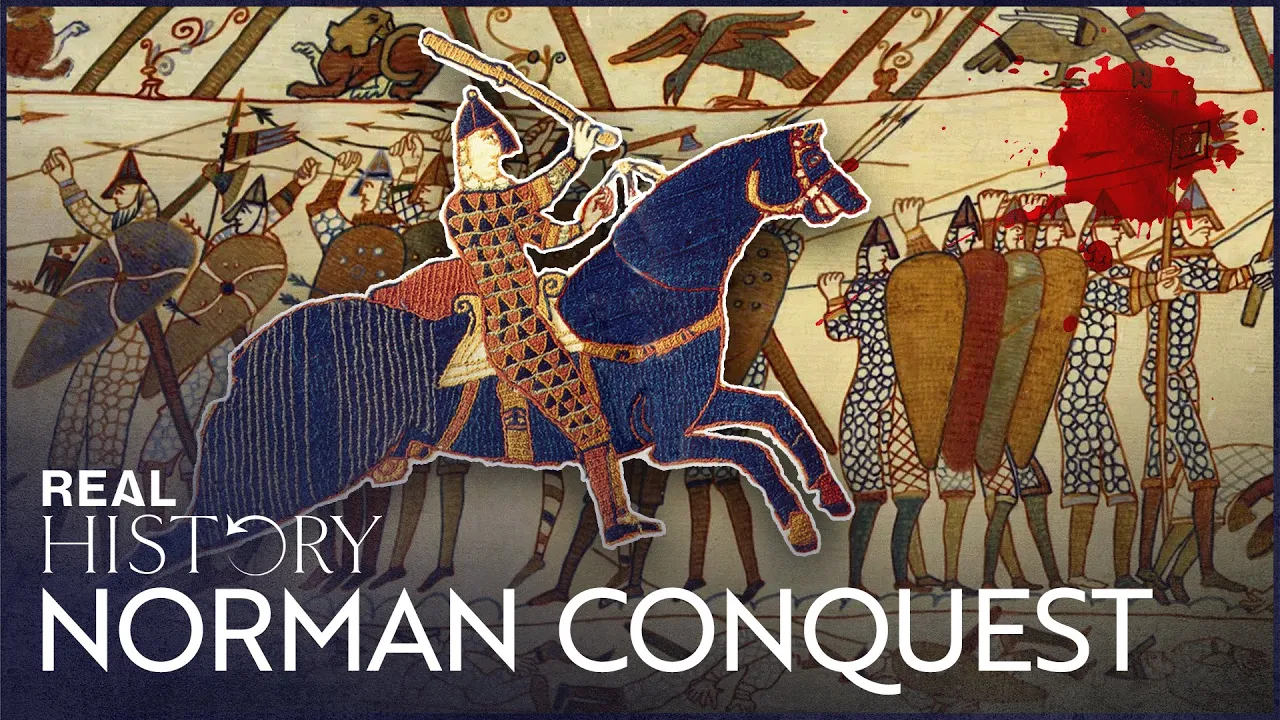
About What Does The Bayeux Tapestry Really Tell Us About 1066? | Dan Snow's Norman Walks
Dan's exploration begins on the Sussex coast, where he travels along the coastline to uncover remaining evidence of Norman invasion and inhabitation, starting in Hastings where William the Conqueror and his army landed.
What Does The Bayeux Tapestry Really Tell Us About 1066? | Dan Snow's Norman Walks is presented by Real History. Its listed runtime is 29 minutes. The source link and publisher attribution are provided with the embedded film.
As a society documentary, What Does The Bayeux Tapestry Really Tell Us About 1066? | Dan Snow's Norman Walks uses bayeux, tapestry, really as its central frame. Social documentaries work best as invitations to examine systems through lived experience. Distinguish individual testimony from wider claims, and consider which institutions, incentives and inequalities shape the choices shown.
What to consider before watching
- What evidence, testimony or observation does the film use to explain bayeux, tapestry, really?
- Which people, institutions or historical conditions most influence the story told in What Does The Bayeux Tapestry Really Tell Us About 1066? | Dan Snow's Norman Walks?
- How does Real History's framing affect the documentary's emphasis, and which perspectives may deserve further research?
Topics covered in this documentary
Documentary details and original source
- Title
- What Does The Bayeux Tapestry Really Tell Us About 1066? | Dan Snow's Norman Walks
- Category
- Society
- Runtime
- 29 minutes
- Language
- English
- Publisher
- Real History
Free Documentary Vault provides independent discovery, organization and editorial context. The film remains hosted by its original publisher, who controls availability and playback.
Related Society documentaries

From the omen of 1066's long-haired star to Hastings and the Harrowing of the North, this episode charts William the Conqueror's brutal rise. In History Makers, we trace the Norman story from Viking roots to the making of a king. We meet Rolf the Ganger and the birth of Normandy under Charles the Simple, then enter William's perilous childhood: assassination plots, the murder of his guardian Osborne Crepon, and years of anarchy. We see the young duke's iron resolve at Alençon, where taunts of "hides for the tanner" triggered a ruthless reprisal, and his strategic marriage to Matilda of Flanders. With Edward the Confessor's death, rival claims ignite. We examine Harold Godwinson's disputed oath in Normandy, William's papal-backed invasion force, and the contrasting battle doctrines of Norman combined arms of archers, spearmen and cavalry, as shown on the Bayeux Tapestry, versus the Anglo-Saxon shield wall and Dane axes. After Harold's dash north to defeat Harald Hardrada and Tostig at Stamford Bridge, the stage is set at Senlac Hill. At Hastings, arrows, infantry and cavalry grind at the Saxon line. When
Real History1066 Hastings: William's 'I Still Live' and the Harrowing of the North

Dan explores what happened after the invasion - where did the Normans go as they cemented their rule? He follows the Welsh border examining one of the most challenging areas the Normans encountered.
Real HistoryHow The Norman Invasion Changed England | Dan Snow's Norman Walks

Historian Dan Snow puts his walking boots on and sets off to see what the great British landscape can teach us about our Norman predecessors. In this episode Dan looks at how the north of England was terroized by the Normans in their conquest of England.
Real HistoryHow The Normans Terrorized The North Of England | Dan Snow's Norman Walks

A headless torso in the River Severn, a missing ex-army captain, and a son found gassed. Our experts revisit 1938's baffling Headless Man case. In Roy Marsden's Incident Room, a 21st century jury of experts re-examines the evidence: psychologist and profiler Kerry Dames, journalist and crime novelist Hilary Bonner, retired senior investigator Mick Turner, and forensic scientist Alan Baker. What was the method? What was the motive? Were clues missed? The timeline opens on January 4, 1938. After sending Nurse Sullivan and his ailing wife Edith to the Gomont to watch Love Is News, Captain William Butte vanished from their Cheltenham home. Weeks later, fishermen near Hawbridge hauled a bloated torso from the River Severn, tied to white bricks with cord; crowds swelled to thousands as more limbs were found, each weighted, the hands and head missing. Meanwhile, on January 24, Nurse Sullivan discovered her son Brian apparently gassed at Tower Lodge. Detectives searching Tower Lodge on February 7 uncovered white bricks ripped from an alcove, identical bricks in the garden, and matching rope and string. The house contained Butte's
Real HistoryThe Headless Man of the Severn: Did Brian Sullivan Kill Captain Butte?

From Tobruk to El Alamein and Operation Torch, see how Montgomery's 8th Army broke Rommel and ended Axis power in North Africa. June 11, 1940: Italy enters the war, threatening Suez and Britain's lifelines. Outnumbered in men and aircraft, General Wavell faces 250,000 Italian troops with thin forces from Egypt to East Africa. Early raids give way to bold counterblows as Bardia falls and Tobruk is taken, but the arrival of General Erwin Rommel and the Afrika Korps reverses fortunes. The siege of Tobruk grinds on, Halfaya Pass is a bruising contest, and on 21 June 1942 Tobruk falls, which Churchill calls one of the heaviest blows he could recall. Churchill arrives with new leadership: General Alexander and General Montgomery. With fresh Sherman tanks and RAF cover, Monty launches Operation Lightfoot on 23 October 1942, a night-long barrage that shocks the Axis. Fighting through deep minefields and fierce counterattacks, the Allies wear the enemy down. Operation Supercharge on 2 November breaks the line and forces a retreat. The 8th Army pursues fast, regaining Mersa Matruh, recapturing Tobruk on 13 November
Real HistoryEl Alamein to Tunis: How Montgomery Broke Rommel's Afrika Korps

Matt Lewis explores the fascinating history of Conwy Castle on the coast of North Wales. Towards the end of the turbulent and blood-soaked 13th century, King Edward I of England sought to impose his rule on the rest of Britain. He set his sights first on Wales. Edward would build his infamous Ring of Iron, a series of castles designed to strangle Welsh resistance. Conwy was to be the royal jewel, with not only a castle, but a walled town stamping English control into the heart of Wales. From architectural experts to stonemasons, Matt will discover the castle’s French connections and how to spot them today. Historian Nathen Amin tells the story of Conwy’s connection to the Tudors, a Welsh family that would change British history forever. From Edward I’s hidden room in the chapel to the tale of a small boy who was the centre of a miracle, Conwy has wrapped hundreds of years of stories within its formidable walls. Let us know in the comments where you think the next series should go next in the hunt for
History Hit