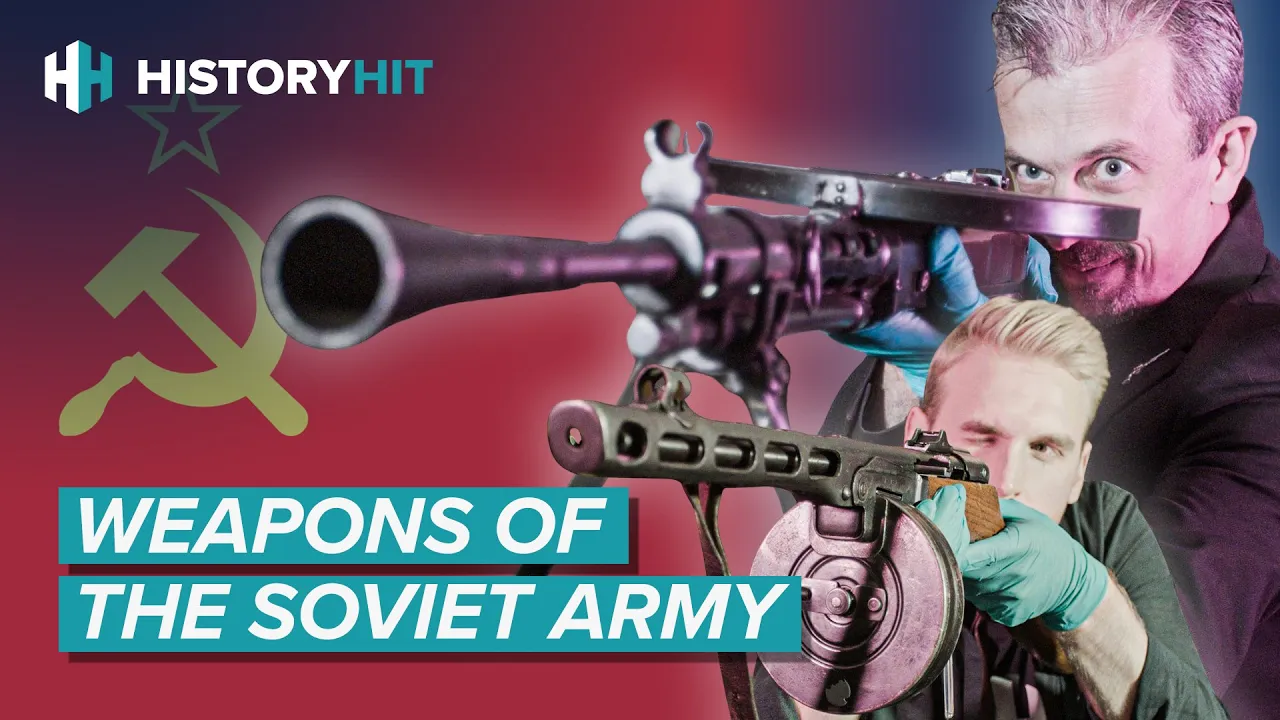
About We Fired Russian WW2 Weapons!
Luke Tomes returns to the Royal Armouries in Leeds to fire some of the most iconic weapons of the Second World War belonging to the Soviet Red Army. As always he is joined by Keeper of Firearms & Artillery, Jonathan Ferguson who talks him through the history of all the pistols, rifles and machine guns employed in the conflict. First up is the TT-33, a sidearm equipped by most soldiers of the Soviet Army during the Second World War. The TT-33 or ‘Tokarev’ Pistol was named after its designer Fedor Tokarev, and was initially conceived as a modern replacement for the aging Nagant M1895 revolver. The simplicity of its design as well as an improvement in firepower would result in the production of over a million of the pistols by the end of the conflict. Second is the Mosin-Nagant bolt-action rifle, the standard infantry weapon of the Red Army during World War II. Originally designed in 1891, the rifle would undergo several modifications before its M91/30 variant became standard issue for the Soviets. By the time World War Two had
We Fired Russian WW2 Weapons! is presented by History Hit. Its listed runtime is 52 minutes. The source link and publisher attribution are provided with the embedded film.
As a society documentary, We Fired Russian WW2 Weapons! uses fired, russian, weapons as its central frame. Social documentaries work best as invitations to examine systems through lived experience. Distinguish individual testimony from wider claims, and consider which institutions, incentives and inequalities shape the choices shown.
What to consider before watching
- What evidence, testimony or observation does the film use to explain fired, russian, weapons?
- Which people, institutions or historical conditions most influence the story told in We Fired Russian WW2 Weapons!?
- How does History Hit's framing affect the documentary's emphasis, and which perspectives may deserve further research?
Topics covered in this documentary
Documentary details and original source
- Title
- We Fired Russian WW2 Weapons!
- Category
- Society
- Runtime
- 52 minutes
- Language
- English
- Publisher
- History Hit
Free Documentary Vault provides independent discovery, organization and editorial context. The film remains hosted by its original publisher, who controls availability and playback.
Related Society documentaries

How has the sniper rifle evolved over the last 100 years? It's time to find out! Luke Tomes returns to the Royal Armouries to fire some of the most iconic British sniper rifles of the last 100 years. As always, he is joined by Keeper of Firearms & Artillery, Jonathan Ferguson, who talks him through the history, design and development of each rifle, showcasing how British military sniping has evolved from the battlefields of the Second World War to the modern era. First up is the Lee-Enfield No. 4 Mk. I (T), the dedicated sniper variant of the British Lee-Enfield rifle developed during the Second World War. Chambered in .303 British, the No. 4 Mk. I (T) was selected for its accuracy and fitted with a telescopic sight, transforming the already proven Lee-Enfield into a specialist precision weapon. Used extensively by British and Commonwealth forces, it combined the fast, smooth action of the Lee-Enfield with the precision required for long-range shooting. It established a foundation for British military sniping that would influence specialist rifles for decades to come. Second is
History HitWe Fired the Most Iconic Sniper Rifles (Over Last 100 Years)

Hero in war. Villain in peace? Historian Kevin Ruane answers your questions about Winston Churchill, the two-time Prime Minister celebrated for leading Britain through the Second World War, yet still one of the most controversial figures in modern British history. You can now become a History Hit member right here on the original video platform! Join for access to a new exclusive documentary every week, and access to over 160+ of our documentaries presented by world-renowned historians like Dan Snow, Eleanor Janega, Tristan Hughes, Mary Beard, Matt Lewis and more.
History HitWhat Do Historians Really Think of Winston Churchill?

Apex predators like tigers, lions, bears, and crocodiles are some of nature's most formidable hunters, and their teeth and claws are a crucial part of what makes them the rulers of the food chain. These animals have evolved powerful, sharp teeth designed for cutting, tearing, and crushing, allowing them to efficiently kill and consume their prey. Tigers and lions, for example, boast elongated canine teeth that enable them to deliver fatal bites to large animals, while their strong jaws provide a crushing force that secures their position as top predators. Bears, with their massive paws and sharp claws, can not only grasp and immobilize prey, but also dig and defend themselves when needed. Crocodiles, with their razor-sharp teeth and incredibly strong bite force, can take down even the largest prey with deadly efficiency. Together, these features not only help these apex predators secure food but also protect them from threats, reinforcing their dominance in the wild. In this episode of Animal Armory, we explore how these specialised traits contribute to their survival and why they remain unmatched in the animal
Real WildWhat Makes Lions & Tigers The Ultimate Apex Predators

Join woodsman and survival expert Ray Mears as he embarks on a unique journey to uncover the truth behind one of Britain’s most enduring legends: Robin Hood. Blending his totally unique knowledge of wilderness skills with a passion for history, Ray explores the landscapes, forests, and historical records that have shaped the myth of the heroic outlaw. From Sherwood’s ancient oak to a document hidden in a medieval castle library, he examines the evidence for the man behind the legend, asking whether Robin was a real figure, a combination of a number of people, or a timeless symbol of justice. To help him on his quest Ray has enlisted the help of a team of experts and some close friends who can help bring to life the harsh realities of medieval life and highlight the real history that is contained within the tale of Robin Hood. You can now become a History Hit member right here on the original video platform! Join for access to a new exclusive documentary every week, and access to over 160+ of our documentaries presented
History HitRobin Hood, Fact or Fiction?

Dan is joined by author, broadcaster and historian Professor Alice Roberts to examine how Christianity out-organised and outlasted the Roman Empire. Around 50 CE, a small group of travellers began to preach that a Jewish man, crucified by the Romans, had risen from the dead. Teaching love, forgiveness and eternal life, this new faith quickly gained followers. By the early fourth century, it was thriving, and over the next hundred years, it exploded, spreading across the entire Roman Empire before becoming its official religion. What enabled it to take such a strong hold so quickly and so steadfastly? Produced by James Hickmann and Mariana Des Forges, and edited by Matthew Wilson and Dougal Patmore. You can now become a History Hit member right here on the original video platform! Join for access to a new exclusive documentary every week, and access to over 160+ of our documentaries presented by world-renowned historians like Dan Snow, Eleanor Janega, Tristan Hughes, Mary Beard, Matt Lewis and more.
History HitAlice Roberts On The Origins of Christianity

Cricket represents values of fair play, integrity, and honesty. It originated in England in the late 16th century and has grown to become the world's second most popular sport. The International Cricket Council (ICC) governs the sport internationally and has members from over one hundred countries and territories, although only twelve play Test cricket – regarded as the sport's most prestigious and traditional form. Two journalists from opposite backgrounds, Sampson Collins and Jarrod Kimber met over their love for cricket and set out in 2011 to make a movie about the future of the sport. They followed the life of a debuting test cricketer, the Australian Ed Cowan; explored the ideological war between the traditional Test cricket and cricket T20, a shortened version of the sport; and started looking for answers on the administrative side of the game, only to stumble upon one of the biggest sporting scandals ever. Taking on the role of investigative journalists, filmmakers Collins and Kimber caught the attention of some powerful people, which made the completion of their film increasingly difficult. ------- Chapters ▷ 0:00:00
wocomoDOCS