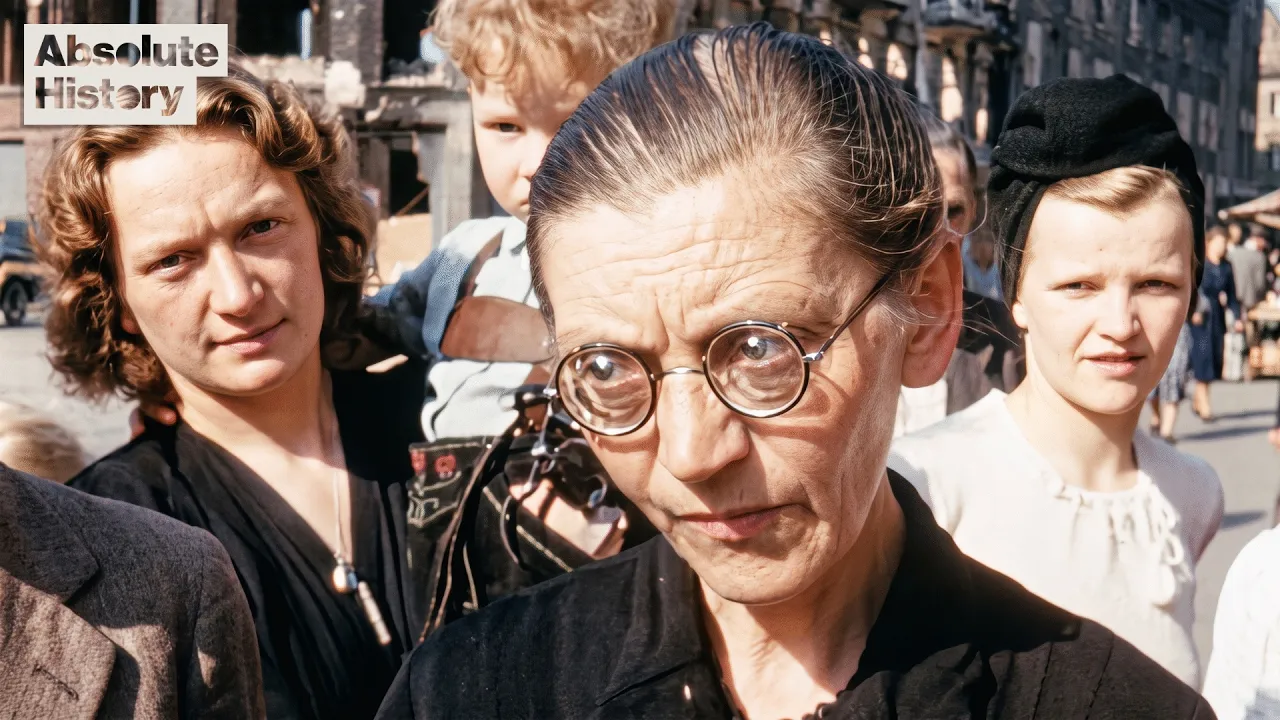
About Victors And The Defeated | End Of The War In Color Uncensored
We look at the aftermath of World War II in Berlin in July 1945, from the destruction of Berlin and the Allied occupation to the struggles of Berliners - especially women - to rebuild their lives amid ruins, rationing, and uncertainty about the city's future. This episode also covers the Soviet victory parade in Moscow and the tense beginning of Allied negotiations at the Potsdam Conference to decide Germany's and Europe's fate. 💚 Join the Absolute History club to get access to exclusive member benefits! 📺 You can now become a History Hit member right here on the original video platform! Join for access to a new exclusive documentary every week, and access to over 160+ of our documentaries presented by world renowned historians like Dan Snow, Eleanor Janega, Tristan Hughes, Mary Beard, Matt Lewis and more.
Victors And The Defeated | End Of The War In Color Uncensored is presented by Absolute History. Its listed runtime is 46 minutes. The source link and publisher attribution are provided with the embedded film.
As a politics & war documentary, Victors And The Defeated | End Of The War In Color Uncensored uses victors, defeated, color as its central frame. Political documentaries frame contested decisions through selected evidence and voices. Identify the institutions involved, the historical timeline, whose interests are represented and which perspectives are absent or disputed.
What to consider before watching
- What evidence, testimony or observation does the film use to explain victors, defeated, color?
- Which people, institutions or historical conditions most influence the story told in Victors And The Defeated | End Of The War In Color Uncensored?
- How does Absolute History's framing affect the documentary's emphasis, and which perspectives may deserve further research?
Topics covered in this documentary
Documentary details and original source
- Title
- Victors And The Defeated | End Of The War In Color Uncensored
- Category
- Politics & War
- Runtime
- 46 minutes
- Language
- English
- Publisher
- Absolute History
Free Documentary Vault provides independent discovery, organization and editorial context. The film remains hosted by its original publisher, who controls availability and playback.
Related Politics & War documentaries

Discover unpublished and rarely seen photographs from the Battle of Berlin in 1945, brought together in an exclusive collection for history enthusiasts. More than 200 historical photographs take you through the final days of the Third Reich and reveal scenes rarely shown in documentaries. World War II began for Poland on September 1, 1939, when the forces of Nazi Germany crossed its borders, launching a massive land and air invasion. Just sixteen days later, the Soviet Union invaded the country from the east, in accordance with the secret protocols attached to the Molotov-Ribbentrop Pact. Trapped between two major powers, the Polish army fought under extremely difficult conditions until organized resistance was broken. However, the fall of Polish territory did not spell the end of Poland's participation in the war. During the occupation, the Polish population was subjected to a brutal policy of repression, persecution, deportations, and executions. Nazi Germany turned the occupied territory into one of the main theaters of the Holocaust, establishing ghettos and extermination centers where millions of Jews—mostly Polish Jews—were murdered, alongside the persecution and killing of
Der Kommandant EnglishALL of World War II from the Perspective of POLAND | IN FULL COLOR

Discover unpublished and rarely seen photographs from the Battle of Berlin in 1945, brought together in an exclusive collection for history enthusiasts. More than 200 historical photographs take you through the final days of the Third Reich and reveal scenes rarely shown in documentaries. The German-Soviet War of 1941 to 1945 was the most gigantic and deadliest theater of operations in World War II. It all began on June 22, 1941, when Nazi Germany launched Operation Barbarossa, mobilizing millions of soldiers alongside its allies against the Soviet Union. Within a few weeks, German forces advanced hundreds of kilometers, destroyed or captured massive Soviet formations, and occupied vast territories. From the border battles to the encirclements of Minsk, Smolensk, and Kyiv, it seemed as if the Red Army was on the brink of collapse. However, Soviet resistance, the immense distances, and the onset of winter transformed a campaign that Hitler hoped to resolve quickly into a war of attrition. Between late 1941 and 1942, the front became a brutal struggle for survival. The German offensive against Moscow was halted and followed
Der Kommandant EnglishALL the German-Soviet War (1941–1945) Day by Day | Documentary in FULL COLOR

The final weeks of World War II in Europe unfold as Allied forces cross the Rhine and close in on Berlin while the Red Army launches its decisive assault on Hitler's capital. The liberation of Nazi concentration camps reveals the true horrors of the Holocaust, even as fierce fighting continues in Germany and the Pacific. With Hitler's regime collapsing and Soviet and American forces meeting on the Elbe, victory is finally within reach—but the political struggle for post-war Europe is only just beginning.
The War RoomThe Fall of Hitler: Berlin 1945

Discover unpublished and rarely seen photographs from the Battle of Berlin in 1945, brought together in an exclusive collection for history enthusiasts. More than 200 historical photographs take you through the final days of the Third Reich and reveal scenes rarely shown in documentaries. World War II from the British perspective is the story of a nation that began the conflict facing a threat that seemed to grow without limits. When Germany invaded Poland in September 1939, the United Kingdom declared war on the Third Reich, initiating a struggle that would last for nearly six years. Following the fall of France in 1940, the British stood virtually alone in Western Europe against German expansion. Under the leadership of Winston Churchill, the country prepared to resist a potential invasion while mobilizing all of its military, economic, and human resources. One of the decisive moments came with the Battle of Britain, when the Royal Air Force clashed with the Luftwaffe for control of the skies. At the same time, London and other British cities endured intense bombings during the Blitz. But the
Der Kommandant EnglishALL of World War II from the BRITISH Perspective | DOCUMENTARY

Discover unpublished and rarely seen photographs from the Battle of Berlin in 1945, brought together in an exclusive collection for history enthusiasts. More than 200 historical photographs take you through the final days of the Third Reich and reveal scenes rarely shown in documentaries. The desert has no memory. It holds no grudges. It does not distinguish between the victor and the vanquished. Under the same sun that crushed Rome and the Caliphate, beneath the same sky that saw Alexander pass, the men of the 20th century arrived with tanks, airplanes, and the certainty that this time, in this place, the second greatest war in history would be decided. One hundred and fifty-two thousand square kilometers of sand between the Atlantic and the Nile. A theater of operations so vast that the columns of smoke from Benghazi could be seen from the sea. So arid that men died of thirst before a bullet ever found them. Three years. Three different Allied commanders. One million soldiers from sixteen countries. And in the end: two hundred and fifty thousand Axis prisoners, surrendering
Der Kommandant EnglishALL of World War II in North Africa 1940–1943 | Day by Day

Discover unpublished and rarely seen photographs from the Battle of Berlin in 1945, brought together in an exclusive collection for history enthusiasts. More than 200 historical photographs take you through the final days of the Third Reich and reveal scenes rarely shown in documentaries. The Third Reich was much more than Adolf Hitler and the Nazi Party. Between 1933 and 1945, Germany was progressively transformed into a dictatorship in which state institutions, party organizations, security forces, and different sectors of society were subjected to a deeply complex authoritarian system. Although Hitler concentrated ultimate authority, beneath him lay a massive structure made up of ministers, regional leaders, bureaucrats, military officials, and organizations that constantly competed for power and influence. Inside the regime, traditional institutions coexisted with new organizations created or controlled by the Nazis. The Nazi Party, the SS, the Gestapo, the SD, and numerous administrative bodies carried out different and sometimes overlapping functions. At the same time, figures such as Heinrich Himmler, Hermann Göring, Joseph Goebbels, and Martin Bormann built their own spheres of influence around Hitler. This internal competition
Der Kommandant English