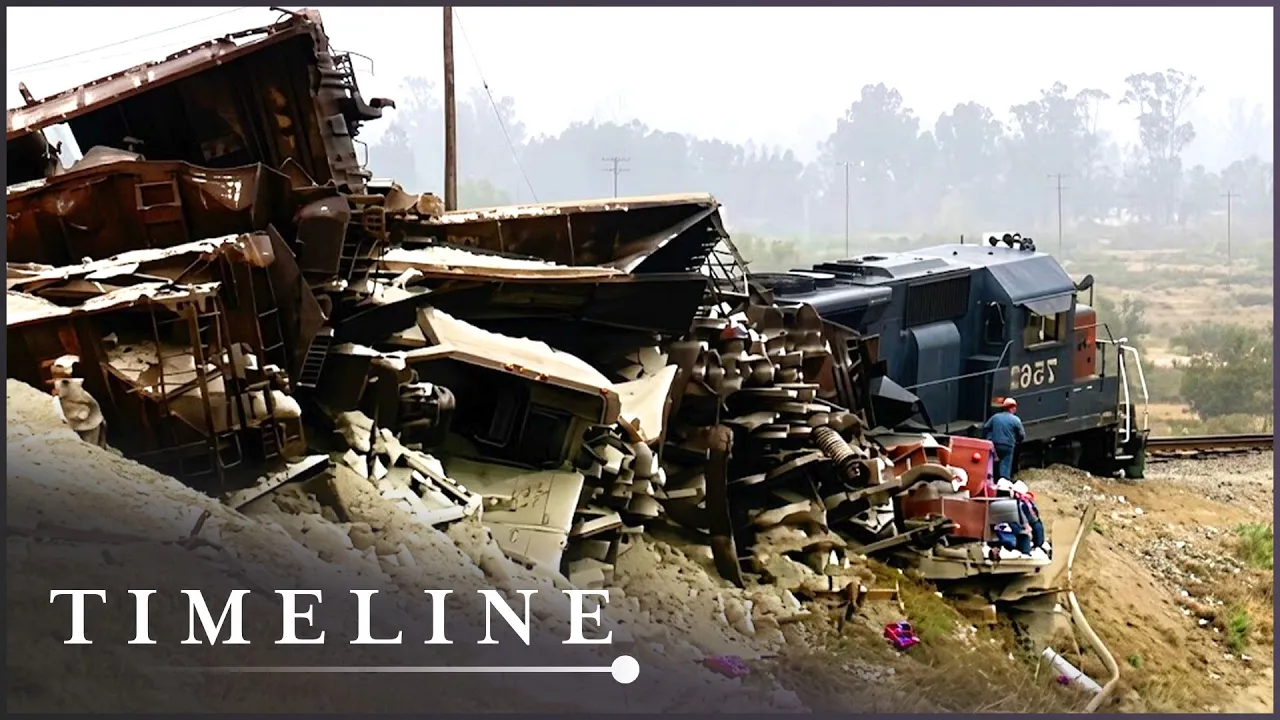
About San Bernardino Train Crash: What Caused This 100mph Runaway Train?
On May 12, 1989, Southern Pacific freight train 7551 rocketed down California’s Cajon Pass at over 100 mph before derailing into a San Bernardino neighborhood. Caused by fatal weight miscalculations and failing brakes, the crash killed four people and destroyed seven homes. But thirteen days later, a second catastrophe struck the exact same street when a damaged underground pipeline ruptured, igniting a massive inferno. This documentary investigates the series of tragic human errors, mechanical failures, and oversight lapses that led to one of the most disastrous chain reactions in American transportation history. You can now become a History Hit member right here on the original video platform! Join for access to a new exclusive documentary every week, and access to over 160+ of our documentaries presented by world renowned historians like Dan Snow, Eleanor Janega, Tristan Hughes, Mary Beard, Matt Lewis and more. This channel is part of the History Hit Network. Any queries, please contact owned-enquiries@littledotstudios.com
San Bernardino Train Crash: What Caused This 100mph Runaway Train? is presented by Timeline - World History Documentaries. Its listed runtime is 50 minutes. The source link and publisher attribution are provided with the embedded film.
As a transport & logistics documentary, San Bernardino Train Crash: What Caused This 100mph Runaway Train? uses bernardino, train, crash as its central frame. Transport films uncover systems that normally remain invisible until something fails. Look for the coordination between people, vehicles, control technology, maintenance and contingency planning.
What to consider before watching
- What evidence, testimony or observation does the film use to explain bernardino, train, crash?
- Which people, institutions or historical conditions most influence the story told in San Bernardino Train Crash: What Caused This 100mph Runaway Train??
- How does Timeline - World History Documentaries' framing affect the documentary's emphasis, and which perspectives may deserve further research?
Topics covered in this documentary
Documentary details and original source
- Title
- San Bernardino Train Crash: What Caused This 100mph Runaway Train?
- Category
- Transport & Logistics
- Runtime
- 50 minutes
- Language
- English
Free Documentary Vault provides independent discovery, organization and editorial context. The film remains hosted by its original publisher, who controls availability and playback.
Related Transport & Logistics documentaries

The War Train Built to Do the Impossible | Trains At War | Season 1 Episode 3 examines the specific people, events and evidence presented in this documentary. Trains at War takes you deep into the fascinating history of trains on the battlefield, revealing how railways became a powerful weapon of war. From transporting soldiers and weapons to moving vital supplies, trains played a crucial role in military operations and changed the way wars were fought. Discover the incredible world of armored trains, military railways, troop transports, and wartime locomotives. Explore how nations used rail networks to move armies across vast distances, support major offensives, and keep their forces supplied under the most challenging conditions. Trains at War brings together military history, railway technology, and dramatic wartime stories in one fascinating journey. If you enjoy war documentaries, military history, historic trains, and untold stories from the past, this documentary offers a unique look at the machines and railways that helped shape modern warfare.
Banijay HistoryThe War Train Built to Do the Impossible | Trains At War | Season 1 Episode 3

Railways That Won the Normandy Invasion | Trains At War | Season 1 Episode 4 examines the specific people, events and evidence presented in this documentary. Trains at War takes you deep into the fascinating history of trains on the battlefield, revealing how railways became a powerful weapon of war. From transporting soldiers and weapons to moving vital supplies, trains played a crucial role in military operations and changed the way wars were fought. Discover the incredible world of armored trains, military railways, troop transports, and wartime locomotives. Explore how nations used rail networks to move armies across vast distances, support major offensives, and keep their forces supplied under the most challenging conditions. Trains at War brings together military history, railway technology, and dramatic wartime stories in one fascinating journey. If you enjoy war documentaries, military history, historic trains, and untold stories from the past, this documentary offers a unique look at the machines and railways that helped shape modern warfare.
Banijay HistoryRailways That Won the Normandy Invasion | Trains At War | Season 1 Episode 4

James May's Toy Stories | S1E05 | Hornby James attempts to build the longest ever model railway track – a whopping ten miles long. He builds it in Devon, linking two towns, Barnstaple and Bideford, who last had a train service over forty years ago Documentary Central is the home for compelling documentaries tackling subjects like history, climate change, wildlife, conspiracy and more.
Documentary CentralHow the World’s Longest Model Railway Track was Built | James May's Toy Stories

Inside Frankfurt Airport: The Technology Behind Its New Mega Terminal | FD Engineering As Frankfurt Airport's Terminal 3 takes shape, engineers turn an enormous construction site into a functioning airport. Giant glass panels are lifted onto the control tower, the first 32-ton automated Skyline train arrives, passenger areas take shape, and engineers install kilometers of technical infrastructure. Deep inside the terminal, engineers begin commissioning the automated baggage system that will eventually move luggage through 15 kilometers of conveyors. ▬▬▬▬▬▬▬▬▬ ▬▬▬▬▬▬▬▬▬ “Engineering: the branch of science and technology concerned with the design, building and use of engines, machines and structures.” So says the Webster definition. Our newest Free Documentary family member, Free Documentary - Engineering, focuses on engineering and brings our community the best engineering documentaries.
Free Documentary - EngineeringInside Frankfurt Airport: The Technology Behind Its New Mega Terminal

World War Two reshaped naval warfare, with secret weapons playing pivotal roles. This episode explores these transformative innovations. We examine advances in submarine warfare, from the Japanese I400 submarines to the German Type XXI U-boats, along with groundbreaking systems like the URSEL Rocket U-boats and the UGS Manta, a craft merging hydrofoil speed with midget submarine stealth. Engineering marvels, from Mulberry Harbours to Yamato-class battleships, show nations' quests for an edge. We also touch on visionary concepts, like an aircraft carrier crafted from Pykrete. -- Welcome to the official Get.factual the original video platform channel! 🌍 We are a documentary streaming channel covering history, science, technology, and nature. Explore worlds distant, forgotten, and unknown; from the depths of ocean trenches to the far reaches of the cosmos. New uploads of full-length documentaries and docu-series every week!
Get.factualThe Experimental Warships Too Advanced for Their Time

On 21 June 1919, Rear Admiral Ludwig von Reuter ordered 74 German warships scuttled at Scapa Flow. This film shows how and why the German High Seas Fleet sank itself. From Kaiser Wilhelm II's dreadnought obsession and the arms race with Britain to the blockade of the North Sea, we trace how a fleet built to dominate ended up interned off the Orkney Islands. Under British guard near Rossaith and then in Scapa Flow, crews endured months of boredom, bartered medals for soap, and clashed with soldiers' councils as Paris and Versailles dragged on. With the Naval Peace Terms Committee splitting the Allies and the deadline looming, von Reuter reduced his crews to 1,700 loyal men and raised the signal: prepare to scuttle. What followed on Midsummer's Day 1919 was extraordinary. As a British battle squadron steamed out for torpedo practice, German sailors opened sea cocks, destroyed valve threads with hammers or acid, and wedged doors, portholes and hatches so water cascaded through 74 ships. Some rolled and capsized as men scrambled to escape. Local trawlers and a handful of
Real History