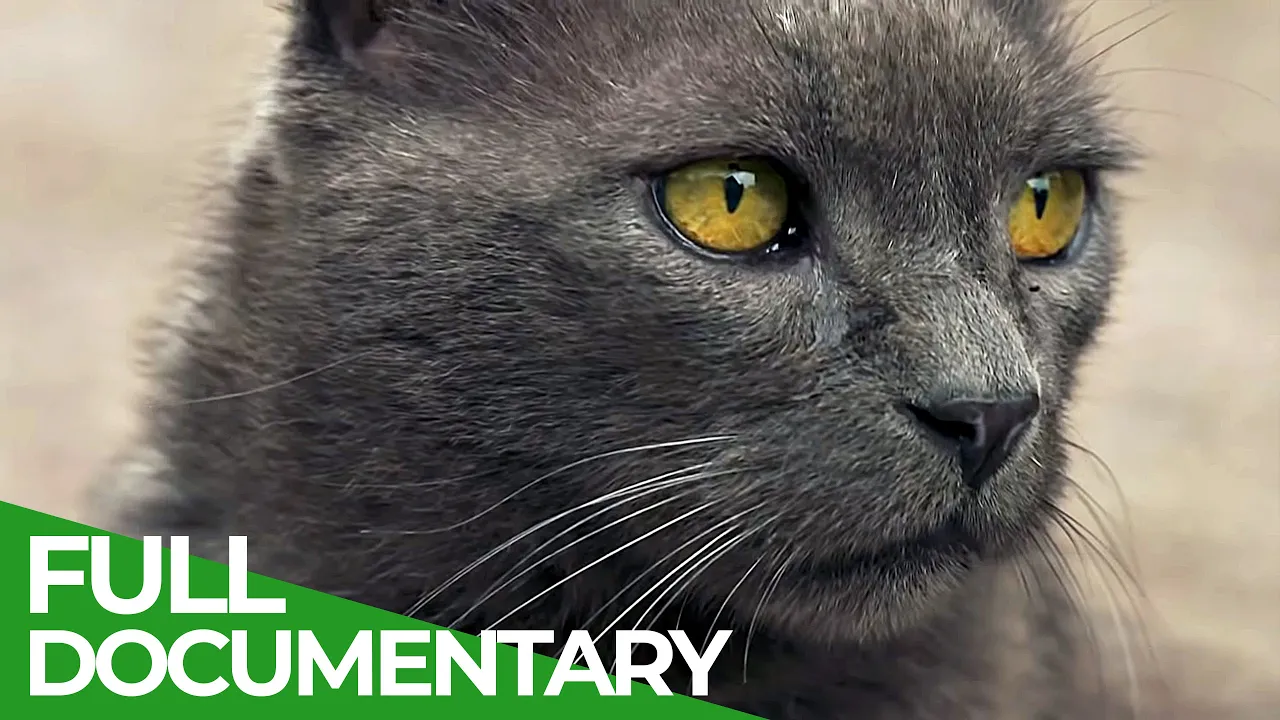
About Follow Your Cat - What Felines get up to When They Leave the House | Free Documentary Nature
Do you know your cat? When she is not purring on your living room sofa - do you know where she roams? Do you know where she wanders off once she leaves the premises? No? Well, would you like to? ▬▬▬▬▬▬▬▬▬ ▬▬▬▬▬▬▬▬▬ ▬▬▬▬▬▬▬▬▬ Free Documentary is dedicated to bring high-class documentaries to you on the original video platform for free. With the latest camera equipment used by well-known filmmakers working for famous production studios. You will see fascinating shots from the deep seas and up in the air, capturing great stories and pictures from everything our beautiful and interesting planet has to offer. Enjoy stories about nature, wildlife, culture, people, history and more to come.
Follow Your Cat - What Felines get up to When They Leave the House | Free Documentary Nature is presented by Free Documentary - Nature. Its listed runtime is 52 minutes. The source link and publisher attribution are provided with the embedded film.
As a nature & environment documentary, Follow Your Cat - What Felines get up to When They Leave the House | Free Documentary Nature uses follow, felines, leave as its central frame. Nature films connect close observation with larger environmental systems. Consider habitat, seasonal change, human activity and the limits of what a single location can demonstrate about a global ecological issue.
What to consider before watching
- What evidence, testimony or observation does the film use to explain follow, felines, leave?
- Which people, institutions or historical conditions most influence the story told in Follow Your Cat - What Felines get up to When They Leave the House | Free Documentary Nature?
- How does Free Documentary - Nature's framing affect the documentary's emphasis, and which perspectives may deserve further research?
Topics covered in this documentary
Documentary details and original source
- Title
- Follow Your Cat - What Felines get up to When They Leave the House | Free Documentary Nature
- Category
- Nature & Environment
- Runtime
- 52 minutes
- Language
- English
- Publisher
- Free Documentary - Nature
Free Documentary Vault provides independent discovery, organization and editorial context. The film remains hosted by its original publisher, who controls availability and playback.
Related Nature & Environment documentaries

Race of Life - Episode 9: Defensive Strategies | Wildlife Documentary Some have powerful strides and flashing teeth, some employ poisons and trickery, so we know for sure that predators are well equipped for survival. But this episode reveals the unique ways in which animals protect themselves. Obviously, being able to flee a predator is the choice of many prey animals but there are also very interesting methods of defense which involve deception and chemistry. These include using toxic chemicals, camouflage, and mimicry. Insects that look like leaves, snakes that play dead, fish that fly, and toads with poisonous skin, these animals are among the many creatures that defend themselves in fascinating ways. Almost every animal is hunted as food by some other kind of animal and has developed ways to defend itself against predators. The relationship between predator and prey is a bit like an evolutionary arms race. As soon as one develops a weapon or defense mechanism, the other is working on an adaptation that allows them to circumvent that mechanism. Common defense mechanisms include claws, teeth, camouflage
Free Documentary - NatureDefensive Strategies | Race of Life | Episode 9 | Free Documentary Nature

Race of Life - Episode 8: Reptiles | Wildlife Documentary Crocodiles, like all living reptiles, are descended from animals that roamed the Earth about 250 million years ago. There’s something so viscerally terrifying about these creatures that lay in wait for their prey, just under the waterline. The comparatively friendly seeming turtle is among the most ancient of the reptiles alive today and has a protective shell that encloses their body and provides protection and camouflage, just as it did millions of years back. They inhabit terrestrial, freshwater, and marine habitats and are found both in tropical and temperate regions. Poisonous or harmless, large or small, all snakes - from the desert rattlesnake to the dwarf pipe snake - have certain things in common: a long, thin shape; scaly, legless bodies; and unblinking, lidless eyes. Like all reptiles, snakes rely on the heat of the sun to control their body temperature. The venom of the king cobra, the world's largest poisonous snake, is strong enough to kill an elephant. Lizards have developed their own adaptations – some lose their tail
Free Documentary - NatureReptiles | Race of Life | Episode 8 | Free Documentary Nature

Survive the Wild - Episode 4: Battle Plans | Wildlife Documentary The ability to fight and win is essential to any animal living in the wild. The strategies of that fight are known as agonism and it can be used to establish hierarchy, secure resources, win territory and seduce mates. In the wild, there are no guarantees. But those that master agonism have the best chance of seeing another day. In the wild every creature has its own game plan. Attack and defence, communication and mating, hunting and claiming territory - for animals to succeed in the turmoil of nature they need strategy. With stunning archival footage and computer generated graphics, we observe the tactics animals use to survive and dominate in the wild. ▬▬▬▬▬▬▬▬▬ ▬▬▬▬▬▬▬▬▬ ▬▬▬▬▬▬▬▬▬ Free Documentary is dedicated to bring high-class documentaries to you on the original video platform for free. With the latest camera equipment used by well-known filmmakers working for famous production studios. You will see fascinating shots from the deep seas and up in the air, capturing great stories and pictures from everything our
Free Documentary - NatureSurvive the Wild | Episode 4: Battle Plans | Free Documentary Nature

Survive the Wild - Episode 3: Cunning Copulation | Wildlife Documentary From microscopic single celled organisms to the largest animals on the planet, one goal is shared by all living things: to reproduce. For many creatures, finding a suitable mate to pass on strong genes and rear young that will survive to adulthood is a challenge that is met with a variety of strategies. In this episode we will observe the creative tactics animals employ to find the best mates and to win them over. In the wild every creature has its own game plan. Attack and defence, communication and mating, hunting and claiming territory - for animals to succeed in the turmoil of nature they need strategy. With stunning archival footage and computer generated graphics, we observe the tactics animals use to survive and dominate in the wild. ▬▬▬▬▬▬▬▬▬ ▬▬▬▬▬▬▬▬▬ ▬▬▬▬▬▬▬▬▬ Free Documentary is dedicated to bring high-class documentaries to you on the original video platform for free. With the latest camera equipment used by well-known filmmakers working for famous production studios. You will see fascinating shots from the
Free Documentary - NatureSurvive the Wild | Episode 3: Cunning Copulation | Free Documentary Nature

Great Smoky Mountains - A Fairytale World from Once Upon A Time | Wildlife Documentary Straddling Tennessee and North Carolina, the Great Smoky Mountains National Park is the most visited in the U.S., drawing 12.5 million visitors annually. Part of the Appalachian chain, the park features some of the highest peaks in the eastern United States and is bisected by the Appalachian Trail. This lush ecosystem supports an incredible 19,000 known species, earning it a reputation for world-class biodiversity. Among its many "critters," the park is famous for: - Mammals: A dense population of 1,500 black bears, reintroduced elk, white-tailed deer, bobcats, river otters, and coyotes. - Amphibians & Reptiles: It is the "Salamander Capital of the World," home to numerous lungless salamanders alongside 39 reptile species. - Birds & Fish: Over 200 species of birds and 50 species of fish inhabit its diverse elevations and streams. - Small Creatures: A vast array of raccoons, foxes, woodchucks, beavers, and bats. From the soaring heights of the Appalachian peaks to the mossy shadows of its ancient woods, the Smokies remain a
Free Documentary - NatureGreat Smoky Mountains - A Fairytale World from Once Upon A Time | Free Documentary Nature

Race of Life - Episode 11: Underwater Defenses | Wildlife Documentary The ocean can be an unforgiving place. Animals living in the sea constantly have to deal with finding food, and protecting themselves from predators. There are many ways of hiding, defending, and feeding, and every different technique has advantages for different animals. For example, some animals use camouflage to escape detection or to sneak up on their prey, while other animals have coloration which intentionally makes them stand out. Some creatures hide from predators, while others stay in groups, out in the open, relying on safety in numbers. Some animals have dangerous spines or venom for protection, but even the most venomous creatures must sometimes be wary of predators. Different animals have taken advantage of different food sources, some feeding at the top of the food chain, and others at the bottom. Protecting themselves underwater is also a matter of invention and reinvention, and aquatic animals deploy an array of strategies just to stay alive. They have quite the toolbox to dip into – Evolutionary strategies such as colour
Free Documentary - Nature