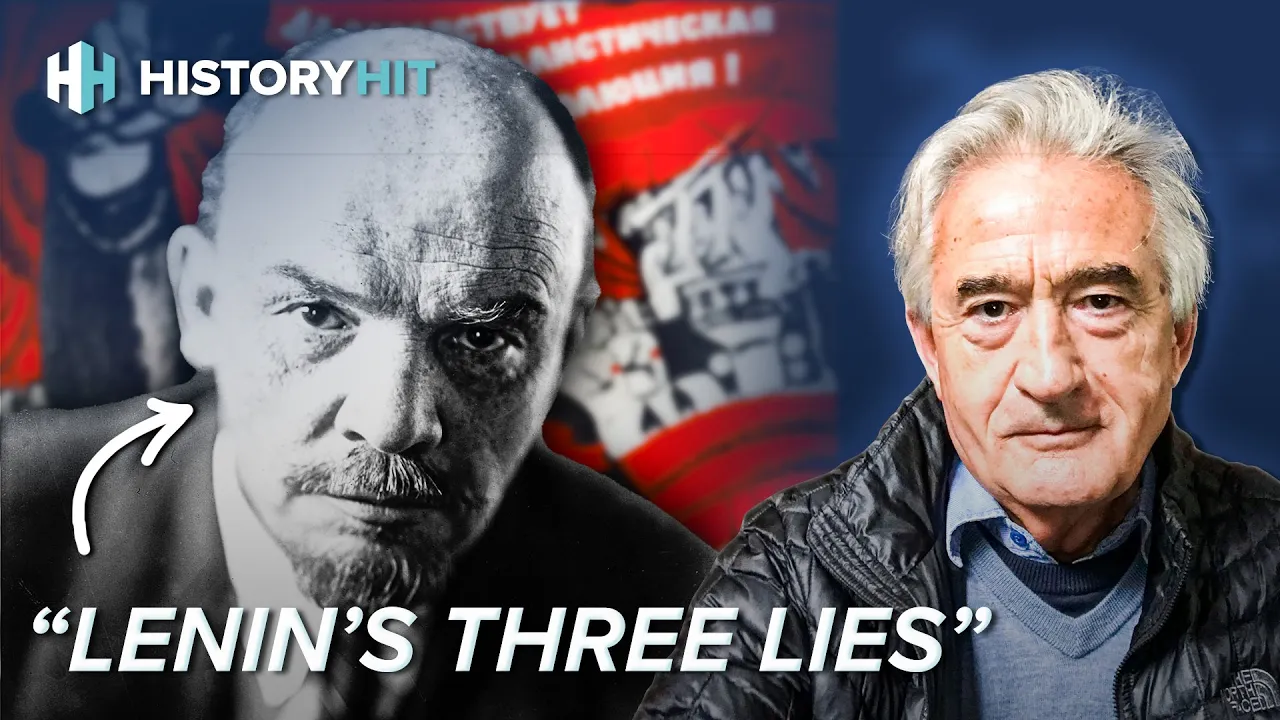
About Antony Beevor Breaks Down the Russian Revolution of 1917
Antony Beevor Breaks Down the Russian Revolution of 1917' Host of History Hit podcast 'Warfare' Dr James Rogers sits down with military historian and author of 'Russia: Revolution and Civil War, 1917—1921', Antony Beevor to discuss the causes and major events of the Russian Revolution. Speaking in the Three John's pub in Islington, allegedly where Vladimir Lenin and Leon Trotsky met in 1903 and sowed the seeds of one of the most significant revolutions in history, the pair cover the February and October Revolution of 1917, the fall of a weak Tsar Nicholas II, the failure of Kerensky's provisional government and the role of the First World War in creating discontent, providing Vladimir Lenin the opportunity to capitalise on chaos.
Antony Beevor Breaks Down the Russian Revolution of 1917 is presented by History Hit. Its listed runtime is 18 minutes. The source link and publisher attribution are provided with the embedded film.
As a politics & war documentary, Antony Beevor Breaks Down the Russian Revolution of 1917 uses antony, beevor, breaks as its central frame. Political documentaries frame contested decisions through selected evidence and voices. Identify the institutions involved, the historical timeline, whose interests are represented and which perspectives are absent or disputed.
What to consider before watching
- What evidence, testimony or observation does the film use to explain antony, beevor, breaks?
- Which people, institutions or historical conditions most influence the story told in Antony Beevor Breaks Down the Russian Revolution of 1917?
- How does History Hit's framing affect the documentary's emphasis, and which perspectives may deserve further research?
Topics covered in this documentary
Documentary details and original source
- Title
- Antony Beevor Breaks Down the Russian Revolution of 1917
- Category
- Politics & War
- Runtime
- 18 minutes
- Language
- English
- Publisher
- History Hit
Free Documentary Vault provides independent discovery, organization and editorial context. The film remains hosted by its original publisher, who controls availability and playback.
Related Politics & War documentaries

Are these the best World War Two air combat scenes in movies? War historian, NATO Advisor and presenter of History Hit’s Warfare podcast James Rogers reviews scenes from films about World War Two that show aerial combat. First up, he reviews scenes from Memphis Belle (1990) which depict the famed B-17F being attacked by a fleet of German planes, praising the film for its historical accuracy in telling the story of the iconic bomber. Next, he rates the scene from Dunkirk (2017) where a dogfight takes place over the English Channel. While he likes the film, he points out that there are a few factual inconsistencies, including the lack of diversity in the actors chosen to portray pilots. James then reviews the Japanese surprise attack from Pearl Harbour (2001), so important in history as it was the trigger for drawing the United States into the war. James praises the film for its accuracy in showing the level of destruction enacted on the harbour. Next, it’s the ending scene from Saving Private Ryan (1998) where Tom Hanks faces off against a
History HitMilitary Historian Reviews the Best WW2 Air Combat Scenes in Movies

Would Britain Have Surrendered to Nazi Germany Without Churchill? The host of History Hit's 'Warfare' podcast James Rogers sits down with author and military historian John Buckley in the (IWM) Churchill War Rooms to discuss his new book: 'The Armchair General: Can You Defeat the Nazis?' In this episode, the two discuss why and how Winston Churchill was chosen to replace Neville Chamberlain, whose policy of appeasement had failed to secure peace in Europe, and how his characteristics enabled him to lead Britain through its so-called Darkest Hour. How did Churchill manage to defeat his greatest political rival Lord Halifax to become prime minister? And what might have happened if Churchill hadn't been chosen to lead the country? How close was he to making a peace deal with Hitler? When was Britain closest to losing the war? What made Winston Churchill the ideal wartime leader? Find out in this video! John's book invites you to take the hotseat and make the key decisions that swung the result of the Second World War. It focusses on eight pivotal moments: Britain's Darkest
History HitWould Britain Have Surrendered to Nazi Germany Without Churchill?

How the Russian Civil War Led to the 'Red Terror' and Infamous Gulag' Host of History Hit podcast 'Warfare' Dr James Rogers sits down with military historian and author of 'Russia: Revolution and Civil War, 1917—1921', Antony Beevor to discuss the causes and major events of the Russian Civil War between 1919 and 1922. Speaking in the Three John's pub in Islington, allegedly where Vladimir Lenin and Leon Trotsky met in 1903 and sowed the seeds of one of the most significant revolutions in history, James and Antony cover the bloody aftermath of the Russian Revolution - a civil war fought between those loyal to the Tsar or simply hostile to Bolshevism and the newly formed Red Army under the leadership Vladimir Lenin, Leon Trotsky, Joseph Stalin and others. But how did Russia descend into such a chaotic conflict? How did the Red Army defeat an overwhelming White Army coalition attacking on three fronts? Where did the 'Gulag' come from? And what made Lenin commit to a campaign of political repression and executions on a scale never seen before, carried
History HitHow the Russian Civil War Led to the 'Red Terror' and Infamous Gulag

Just how brutal was the Soviet Advance on Berlin? Dan Snow and military historian Sir Antony Beevor present the gripping account of the Battle of Berlin, the final, bloody chapter of World War Two in Europe. The pair discuss Joseph Stalin's secret plan to seize the city and its nuclear secrets while deceiving his Western Allies. From the colossal artillery battle at the Seelow Heights to the brutal street fighting in the city, this is the definitive story of the Third Reich's collapse. You can now become a History Hit member right here on the original video platform! Join for access to a new exclusive documentary every week, and access to over 160+ of our documentaries presented by world-renowned historians like Dan Snow, Eleanor Janega, Tristan Hughes, Mary Beard, Matt Lewis and more.
History HitWW2 Historian Explains Bloody Final Days of the War in Europe

Was it the mud? Was it the longbow? Or were French battlefield decisions the real reason they lost? Join medieval historian Matt Lewis as he breaks down the battlefield tactics that shaped the legendary Battle of Agincourt. From Henry V’s calculated use of terrain to the deadly efficiency of the English longbow men, Matt reveals how strategy, not just luck, secured one of the most astonishing victories in medieval history. You can now become a History Hit member right here on the original video platform! Join for access to a new exclusive documentary every week, and access to over 160+ of our documentaries presented by world-renowned historians like Dan Snow, Eleanor Janega, Tristan Hughes, Mary Beard, Matt Lewis and more.
History HitMedieval Military Historian Breaks Down Medieval Battle Tactics

What really tipped the scales in the Allies’ favour during World War II? In this episode, we break down five critical reasons behind the Allied victory - from strategic coordination to Hitler’s own catastrophic mistakes. You can now become a History Hit member right here on the original video platform! Join for access to a new exclusive documentary every week, and access to over 160+ of our documentaries presented by world-renowned historians like Dan Snow, Eleanor Janega, Tristan Hughes, Mary Beard, Matt Lewis and more.
History Hit